
STAFFORDSHIRE BULL TERRIER CLUB
of the U.S.A.
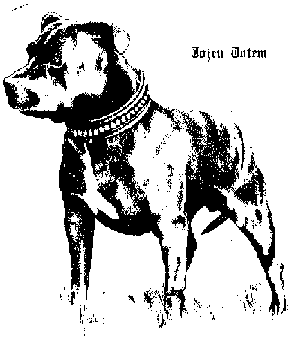
Tojen Totem
The SBTC/USA Club Bulletin No. 17
July 18, 1972
I. Election Results
The complete results of the 1972 SBTC/USA elections are to be found in the enclosed statement from the Notary Public. These were unusual in that there were two ties, one for President and one for Director, and the two candidates for Treasurer both were unable to accept office due to pressing personal reasons. Therefore, the SBTC/USA has two Co-Presidents, Peter La Paglia of Baltimore and Jim De Groff of St. Petersburg, and four Directors instead of three... they are Sally Bichel of Omaha, Jack Crowther of Reseda, Margaret Grigsby of Washington D.C., and Frank McNolty of Sunnyvale, California. Ed Rowland of Park Ridge, New Jersey, is the new Vice-President. Steve Stone of Bellevue, Nebraska, will continue as Secretary and temporarily serve as Acting Treasurer until such time as the Board delegates that position.
II. Cover Drawing
This month's cover drawing from the pen of Meridith "Red" Spiehs features Tojen Totem, a CC-winning dog in England sired by the recently-deceased stud dog Winterfold Danny, featured on the cover of John Gordon's The Staffordshire Bull Terrier Owner's Encyclopedia. Red is currently working on another project involving pictures of many of the old-time Staffords from the very early days.
III. Letters and Litters
Members will find enclosed a type facsimile of Reid Randall's recent letter. In it there are a couple of interesting proposals, one of which would be an event to prove the athletic prowess of our Staffords. To my mind, this is the first time that such a proposal has been made, and it certainly merits careful consideration. The show ring and the obedience ring are worthwhile pursuits, as are hunting field trials, but Reid's suggestion would certainly give our Staffords new worlds to conquer. In Finland, certain breeds will not award Championship status to any individual that does not display certain athletic tendencies. Fox Terriers, for instance, are put into a man-made "earth" near a well-protected (caged) fox, and the terrier is expected to act like a Fox Terrier. Food for thought.
Several Members have had litters recently. Jim De Groff, 2501 67th Terrace North, St. Petersburg, Florida, 33702, is hosting a litter of three pied dogs, one red dog, and two red bitches. Ed Rowland, 125 Split Rock Lane, Park Ridge, N.J., 07656, has a litter of three, two bitches and a dog, which he imported in utero from England. Sally Bichel, 7501 Cass St., Omaha, Nebr., 68114, has three brindle pups, two bitches and a dog, left from "Wendy's" recent litter. Margaret Grigsby, 3256 Chestnut St. N.W., Washington D.C., 20015, has four pups, two dogs and two bitches, sired by her prize-winning Nigerian import Rocky of Ibidan. Jack Crowther 19438 Lorne, Reseda, Calif., 91335, has two brindle pups, a bitch and a dog, from a very recent litter. Irma Rosenfield, 3215 N. 56th, Omaha, Nebr., 68104, still has three red pups, two bitches and a dog, from her recent of eight out of her own homebred bitch, Dynamite Honey. John La Boda, 21761 Robin Hood Dr., Parkview, Ohio, 44126, struck gold when his bitch Carlotta Regina of Ruthen delivered seven bitch puppies, three brindles and four reds. One or two other litters are reported to be on the way.
The SBTC/USA has registered 58 Staffords in 1972 alone as the Stud Book continues to grow apace. Most of these puppies are finding good homes without especial difficulty, but prospective breeders should be made aware of the fact that the puppy market seems to be "down" generally all over the country and in all breeds. There are most certainly a variety of reasons for this, and each person may ascribe his own priorities to them, but the pertinent point is that anyone who breeds without having some kind of firm market in the offing may well find himself saddled with puppies for a longer time than he had counted on. Our Breed has grown at a fantastic rate since the SBTC/USA was first founded in 1967 with 14 dogs in the entire nation---a rate that has not been in every respect entirely healthy. We may now be reaching some kind of point of no return with a spiraling birth rate: three weekends ago in the classified ad section of the Los Angeles Times there were FIVE ads for Stafford pups. Again, if you have good stock and some kind of prospective market, go ahead and breed. If not, reconsider.
IV. News Items
Ed Rowland, newly-elected SBTC/USA Vice President and President/Founder of the eastern regional Associated Staffordshire Bull Terrier Club, reports a steady growth of Membership strength in the New Jersey area and a quickening of interest there. A small fun-match was held recently, and the results will be printed as soon as they come in.
Colin and Kirsti Smith visited in Omaha, from May 13th through May 19th and had a chance to acquaint themselves with the Staffords in the Omaha area. A Rally was held at the home of Stan and Irma Rosenfield on May 14th, and their comments and demonstrations with the dogs were eye-openers for most of the Cornhuskers. A good time was had by all. Colin and Kirsti managed to see quite a bit during their brief stay, including an All-Arabian Horse Show, and were astounded to find that the area has an honest-to-God forest of its very own. They will be most welcome back next year to judge the SBTC/USA show that had to be postponed this year.
Sometimes a puppy will not eat well when first transferred to its new home. One Member---who shall remain nameless---found a remarkable remedy for this condition, Purina Puppy Chow ala Mode. Yes, this Member spread a quantity of vanilla ice cream on top of some Puppy Chow, waited until it was nice and gooey, mixed the two thoroughly, and served it to the puppy who had refused all other proffered goodies. It worked beautifully and after two or three more meals of the same, meat was substituted for the ice cream without any inhibition of appetite on the part of the finicky one.
Pat Cooke, SBTC/USA Member and Secretary of the SBTC/Canada, is currently in England. She hopes to bring back a puppy or two from our Overseas Member Rachael Swindells of the Rossisle prefix. It is possible (but not probable) that while over there Pat met other SBTC/USA Members who were in England at the same time: Ken Woolfenden, Sid Davies, Colin Smith, Edward Byrne, and Dr. Lois Davidson from Australia. Had they all met at one of the big summer Championship Shows, one can well imagine some of the conversation!
V. Services
Secretary/Treasurer Steve Stone will continue to accept Members' orders for subscriptions to The Stafford magazine from England at $2.50 per annum and for autographed copies of John Gordon's three Stafford books at $2.50, $5.50, and $6.50. Orders for Stafford collars at $8.00 and for "Happiness is a warm STAFFORDSHIRE BULL TERRIER puppy" T-shirt (sizes Large, Medium, and Small) at $2.50 are still being accepted. All this is a non-profit service for SBTC/USA Members only.
VI. Enclosures
Member will find a record number of enclosure pages: a) a typed facsimile of Reid Randall's letter, already mentioned; b) the Secretary's letter to Bill Daniels to which there was no reply whatever; c) the Secretary's report on his trip to California; d) the current SBTC/USA Membership List for paid-up 1972 Members; e) an article of historical interest, sent in by Overseas Member Ken Woolfenden; f) reprint of an article currently appearing in the June-July issue of Young World magazine, by courtesy of the 1972 Copyright holder: Review Publishing Company; g) election results certified by the Notary Public; and h) SBTC/USA Membership Cards.
VII. Addenda
The October issue of DOGS magazine, due on the newsstands in August, will carry an article about breeds in the Miscellaneous Class, including the Staffordshire Bull Terrier. Due to reasons that have not been yet determined, the December 1971 letter from author Kathryn Braund to Secretary Steve Stone never arrived, so that a reply was never made. Thus the research for the story was not entirely completed. Nevertheless, it is most gratifying to see our Breed making the pages of a nationally-circulated canine magazine and Stafford fanciers through-out the nation owe Mrs. Braund a vote of thanks.
Few Members were able to obtain copies of Young World because it does not appear on most news-stands. For this reason the enclosed reproduction, without photos, appears herein. Original copies may be had by sending 50¢ to: Young World, 1100 Waterway Boulevard, Indianapolis, Indiana, 46202.
(typed facsimile of handwritten original)
Wednesday, May 24
Dear Steve:
I have read the Bulletin and am absolutely enraged. I can't say that I am greatly surprised at the infantile allegations of "pit fighting" in our Club because I remember only too well their constant use of that term in their logically moronic reply to the letter of resignation I sent them, but I am thoroughly disgusted.
Steve, defamation of character is not a light matter. It is all the more serious as "pit fighting" as I understand it is illegal throughout the U.S. If legal action is necessary, I pledge $25.00 for use in prosecution. I'm sure other Club members will be glad to contribute as much or more. When our Club is attacked in such a vulgar, low-class manner, it reflects badly on all of us. Personally I do not wish to have my name mentioned, however falsely, with that of a "criminal organization."
Demon is up to 30 pounds and is a fine looking Stafford in all but one respect. One ear sticks straight up whenever she is paying attention to anything. I wish I knew if there was any way it could be corrected.
By the way, my pen is 67" high (5 ft 7½ inches, exactly) and Demon is jumping out of it. I consider that to be a good feat for a puppy who is still developing. Indeed, I had always thought that Pepper must be an exceptional Stafford because of her combination of strength, speed, and agility, but now I am not so sure of that. Apparently all Staffords are fantastic athletes. I have measured Demon's full extension and it comes to 44 inches. Thus, her vertical jump is at least 23½". Can any other pup with her speed and strength match that?
Probably no other breed could best a Stafford in a test of all around athletic ability that was properly handicapped for size and weight. Perhaps we could have a "Stafford Tetrathalon": compete our dogs in four events: 1) one mile run for time; 2) vertical jump; 3) time sprint; and 4) weight-pulling in harness. It's a fanciful idea, of course, but it would be fun if we had the proper facilities for an accurate testing of all entries.
(signed)
Reid (Randall)
P.S. I notice that Demon is getting one inch above the pen height and is jumping out of a hole two inches deep, making a vertical jump of 26½".
(Dear Reid - Raise your pen 18 inches - then Demon will have a vertical clearance of 44½" when she jumps out! Steve)
The Staffordshire Bull Terrier Club of the U.S.A.
1005 Dogwood CircleBellevue, Nebraska 68005
SBTC/A
5237 Escalante Road
La Canada, California 91011
Dear Bill,
I will be in Denver over March 26-28 on special assignment for the U.S. Corps of Engineers and will then go on to visit my folks in Pasadena, March 29-April 2nd.
My visit to southern California could give us the chance to meet and discuss ways to resolve the differences that have plagued the Stafford movement for the past 20 months, hopefully moving the two Clubs toward eventual unification, say, in January of 1973.
If you wish, I will bring full authorization from the Board to negotiate and I'm sure you can do likewise. At this particular junction of world and national affairs, now seems to be a singularly appropriate time for both sides to put aside personal animosities and past ills to work for sensible compromises, but not to capitulate, to assure a stronger and unified future for the Breed. Surely if we meet and talk in good faith, without personal aspiration, much can be accomplished.
And surely, since I will be in Los Angeles anyway, it is best for all concerned to act in concert and cooperation.
Your reply in the affirmative would be appreciated at the earliest possible moment so that we would have ample time to agree beforehand on a place, time, agenda, and like matters.
Sincerely,
Steve Stone
Founder
SBTC/USA
REPORT
Subject: Trip to California
To: SBTC/USA Members
From: Steve Stone, Secretary
In late March, 1972, I left Omaha for Los Angeles via Colorado Springs to visit my parents. There was little or no hope to come to a settlement of differences between the two Stafford clubs, seeing that Bill Daniels had not even answered my letter of February 25th, but I felt that if nothing else going through with the trip would show our sincere good intentions.
I stopped off in Denver to meet Bob and Margaret Wiltfong and their two year old brindle dog Tadgh, of Joe Orday's breeding. Tadgh, as it turned out, has come to be the real Stafford article: once he went directly through a burning camp fire to fend off another dog that seemed to be threatening the Wiltfong children, and another time he saved the lives of the two older Wiltfong girls from a night-time intruder. The Wiltfong's were (are) planning to move to Alaska, and Bob's only stated worry was that Tadgh might literally tackle an Alaskan grizzly bear before Bob could teach him to be more cautious.
Half an hour before the plane left Colorado Springs, I learned by phone that my father had died suddenly and unexpectedly from a massive brain hemorrhage, and I lost what little desire I had had to try to negotiate with the not altogether engaging personalities in southern California would style themselves as the latter-day saints of the Stafford movement.
Once in California, most of my time was taken up by personal affairs. I made no attempt to contact the SBTC/A, but I did manage to see some of our SBTC/USA Members in the area and to talk with old Stafford friends. What I learned about the activities of the leadership of the SBTC/A largely confirmed what I had suspected, going far beyond what any rational mind would envision. Briefly, this is what turned up:
1) One out-of-favor fancier who is a member of both clubs had a bitch pup in a litter and she had a movement problem. Certain California club leaders privately and publicly branded the bitch as having hip dysplasia - bruiting the word far and wide in strident tones. The bitch was x-rayed and found clear. Not a syllable of retraction from the slanderers.
2) A Member of the California club board had a litter with two black-and-tan (a color not approved in Staffords) pups and was trying to sell them as "regular" pups. A new fancier innocently inquired of the then-Secretary if black-and-tans were, indeed, "regular." This precipitated virtually an all-out verbal attack on the new fancier by the then-Secretary, culminating in threatening telephone calls at three a.m., threats of out-of-hand dismissal from the club, and eventually the whole thing almost landed in the courts.
3) A married couple past retirement age, members of both clubs, had a fine litter of Staffords, their first after a lifetime of AmStaff litters, despite the fact that the husband was in extremely poor health. Their fine bitch had been mated to a really first-class imported dog from New Zealand. The California club president invited himself over and after looking at the litter told the couple that they should charge no less than $200 per pup as "everyone" in the California club was supposed to be doing. Trying this, the couple had no success because simultaneously the California club president and his friends were selling their own pups at $100-$125. (To me, this represents the all-time moral low.)
4) A longtime breeder of top-quality livestock, a member of both clubs, sold a puppy of his own breeding to a very satisfied customer who later brought the puppy to one of the local unbenched unsanctioned "specialist" shows as a non-entry so that the owner could see other Stafford pups. She was approached by the current California secretary who after opening remarks inquired as to the pup's breeding and price. Then owner was then told that she could have gotten a much better puppy at a much lower price. Shocked, the owner then went over to the breeder at ringside and asked what was going on. The breeder then offered to buy the puppy back at the original purchase price providing that the owner would then purchase one of the secretary's own puppies, at that moment appearing in the ring, at the price previously mentioned. Looking in turn at both puppies, the owner firmly declined his offer and kept her original pup.
5) The owner of a first-class imported dog brought his favorite to one of the early unbenched and unsanctioned shows and was greeted by a spectacle that no Stafford ring in England or any other country has ever witnessed: a measuring bar and a weighing scale. The imported dog, as the owner well knew, was exactly 16½ inches at the shoulder and 42 pounds and was so measured. The owner was then told that his dog was disqualified and that if he ever entered the dog in any later shows a formal protest would be lodged against him. Why? Simply because the dog in question - which although marginally outside the Breed standard is certainly no larger than many Champions in England - was the best dog on the premises and there was no other way to "stop" him.
6) A bitch puppy was exported to Canada by the wife of the then-Secretary in the full knowledge that the bitch could never be registered in Canada and none of her progeny could ever be registered - this despite the fact that the Canadian Stafford folk with really good registrable stock at competitive prices must fight for every sale, not having the large market that we have. The bitch's being non-registrable makes the fact that she went undershot of no real consequence.
7) Anyone who has followed the unbenched and unsanctioned "specialist" shows on the West Coast has come to realize that almost the only dogs ever entered are those owned by the California Board members. Why? Because these are almost the only dogs that ever win anything. How do they do it? Like this: A good reputable American judge of their acquaintance who has never owned and hardly ever even seen a Stafford is selected to judge. The Board members "honor" him with a dinner or such the evening before the show. The Breed Standard is explained, pictures of English dogs are shown, and a few of the dogs owned by Board members are used to illustrate various "fancier's points." Nuff sed.
8) The 1972 SBTC/A election was "fixed" like this: all members were invited to send in nominations for the various offices. There were five nominated for president, six for Vice President, etc. Then a "nominating committee" appointed by the Board selected a ballot with ONE name for each office and - surprise! - most of those names were identical to the then-current officeholders. Several countries who have single-list ballots come to mind...
In brief, it is themselves that they are promoting, not our Breed. It may well be that they will have more success, at least in the near future, but it cannot come to any good in the long run, for the simple truth is this: they are not morally fit to head a unified and genuinely democratic national Staffordshire Bull Terrier movement in this country.
Steve Stone
ARTICLE OF HISTORICAL INTEREST FROM ENGLAND
Throughout the centuries we hear of loved dogs and other creatures, and see them too, painted with their masters in portraits or carved upon their tombs. But these were favoured beasts, basking in sunshine of human love and protection. There were others who, if yet to earn their living by providing sport for gaping crowds on high-days and holidays, or winning money for their masters who betted heavily upon their prowess. Gamecocks, bulls, boars and mastiffs, were all of this number. Fitzstephen speaks of boars being made to fight for the entertainment of Londoners in Henry II's reign; even asses were sometimes baited by dogs in mediaeval times, though, as they did not show much spirit, they were never as popular as other and fiercer beasts.
Baits were held at Court, in market squares, on village greens, and in the famous bear-garden built in 1526 on Bankside in Southwark. Town Councils had their official bears and bear-wards; gentlemen frequently organised baits to celebrate some special event or entertain an honoured guest; foreign ambassadors and similar important visitors were always taken to such shows during the course of their stay in England. When Queen Elizabeth went on progress, her hosts usually included a bait in the amusements devised for her, and certainly no ordinary fair or country festival would have been complete without one. A good fighting bear or bull was the pride of the district, as a bold dog was of its owner, and every Englishman, from the prince to the peasant, unashamedly revelled in the rough and tumble contest between the great beast chained to its stake and the barking, snapping dogs who returned again a again to the attack in spite of the risk they ran from the cruel claws or horns of their savage opponent. Laneham, describing a bait in 1575, declared that:
"It is a sport very pleasant to see the bear, with his pink eyes leering after his enemies; the nimbleness and wait for the dog to take his advantage; and the force and experience of the bear again to avoid his assaults; if he were bitten in one place, how he would pinch in another to get free; that if he were taken once, then by what shift with biting, with clawing, with roaring, with tossing and tumbling, he would work and wind himself from them; and when he was loose, to shake his ears twice or thrice, with the blood and the slaver hanging about his physiognomy." |
The bear, though chained, usually had the best of it. Four or five dogs might be loosed upon him at the beginning, and it was quite common for one or two to be clawed to death within a few minutes. Fresh dogs replaced them, and the fight went on until the bear had proved himself the master or was too much injured to continue for that day. His wounds were carefully tended by the bearwards, who valued their beasts very highly and usually treated them with great kindness. The famous Middlewich bear, Old Nell, used to be taken to the ale-house by her master after a bait and there refreshed with beer; there is a story that she once repaid his kindness by chasing away a terrified constable who came to distrain upon his goods for debt. The brutality of the contests was in keeping with the roughness of the age, but the animals themselves were as carefully tended as any English race-horse or Spanish fighting-bull of today.
Even in its hey-day there were some who deplored the pastime both for its cruelty and because it frequently took place on Sundays. "What christian heart" wrote Stubbes in 1583, "can take pleasure to see one poor beasts rend tear and kill another, and all for his foolish pleasure." Unfortunately most christian hearts could and did take the greatest pleasure in it and even the Puritans who disliked it did so more on religious than on humanitarian grounds. Edward III included it amongst "dishonest, trivial and useless games" but only for the usual reason of his time, that it drew away his subjects from archery. James I forbade it on Sundays, but otherwise fostered it, and himself experimented, not very successfully, with lion-baiting in the Tower of London. Queen Elizabeth frequently held baits at Whitehall and elsewhere for the entertainment of distinguished guests, and it was during her reign that the Privy Council in 1591 forbade the London Theatres to open on Thursdays because they drew away the people from "The game of bearbaiting and like pastimes which are maintained by Her Majesty's pleasure."
As for ordinary people, they had no qualms whatever about the matter. To see a garlanded bull or bear paraded with music through the streets, and then watch it struggle, victoriously or otherwise, against the dogs, was sheer delight to them. It was a spectacle familiar to everyone, from the most sophisticated Londoner to the simplest inhabitant of a remote hamlet. The bear-garden in Southwark was constantly filled with noisy and exicted crowds, as was the adjoining circus opened in 1570 for bull-baiting. During the Commonwealth baits were suppressed, but they began again with the Restoration. Evelyn, who did not care for them, describes a visit to Bankside on 16th June 1670, "where was cock-fighting, dog-fighting and bear and bull baiting, it being a famous day for all these butcherly sports, or rather barbarous cruelties." He calls it, "a rude and dirty pastime", as Pepys had, almost in the same words, four years before, but not many of their contemporaries would have agreed with them. The sport continued all through the eighteenth century, and it was not until the beginning of the nineteenth that a serious effort was made to abolish it. In 1802 a Bill for this purpose was introduced into Parliament. It was defeated by a majority of thirteen, mainly through the eloquence of Mr. Windham, who declared it was prompted by Jacobins and Methodists in an attempt to make the people grave and serious and so pave the way for strange and un-English innovations. In 1835, however, the abolitionists were victorious and baiting was finally forbidden. Even then it persisted secretly and in quiet places, for some years, so deeply rooted was it in the effections of the people.
One of the last bull-baits is said to have been held as late as 1853, in West Derby, now part of Liverpool, but at that time a village outside its boundaries.
The annual bull-running at Stamford was an even more savage performance than the customary bull-baits which were at least governed by definite rules and were fought only by animals specially trained for this purpose. This ancient custom was supposed to have started in King John's reign when William de Warenne saw two bulls fighting in a field. Some butchers' dogs attacked them and chased one bull right through the town, and this so delighted de Warenne that he gave the field to the butchers on condition that they provided a bull every year for the running.
Whatever may be the truth of this tale, it is a fact that for centuries a wretched bull was turned loose in the streets on 13th November and hunted through the town by dogs and a shouting, singing mob of men and women, all armed with clubs and staves and led by a ribbon-bedecked individual known as the Bull Queen. If a bull would not run it was beaten until it did; the great object of the hunt was to get it onto the bridge and from thence to chase or hurl it into the river and out again over the muddy fields adjoining. While the chase lasted, pandemonium reigned. Guards were posted to protect travellers passing along the Great North Road which runs through the town, but except for this all normal rules were suspended for the day. Shopkeepers barricaded their shops and joined in the hunt, and Peck tells us that "the Streets are filled with Heroes who bandy the Dirt about their own Dublets, and take care that every Body who appears with a clean face shall not want a dirty one." When at last all were exhausted, the bull was killed and roasted; the meat was given or sold at a low price to the poor, and the "Great Gut or Pudding, commonly known as Tom Hodge," was presented to the hunter who had most distinguished himself during the day.
A similar but even more barbarous custom was observed at Tutbury during the Minstrels' Festival in August. This was summarily abolished by the Duke of Devonshire in 1778, but the Stamford bull-running was less easily suppressed.
In 1788 the Mayor and Lord Exeter attempted to stop it, and were openly insulted for their pains. Fifty-five years later the Society for the Prevention of Cruelty to Animals tried again, with the unfortunate result that the independent townsfolk, enraged by the interference of "a London society", became even more enthusiastic than before. Undaunted by this failure, the Society sent down several officers in 1836, and a riot followed in which the officers were roughly handled and many windows broken. Eight men were arrested; a fund was immediately raised for their defence, and many who detested the bull-running contributed generously to it because they felt the prisoners had been unfairly treated. At the Lent Assizes all but three were acquitted, and these last were released on bail. This was regarded as a victory for the "bullards", and the running took place as usual in the following November.
Urged on by the Home Secretary, the town authorities then took a hand. In 1838 they enrolled a large number of special constables and imported a troop of soldiers and some metropolitan police. The streets were patrolled to prevent the entry of any bull and suspected premises were carefully searched. Nevertheless, the bull was duly run, and there was a sharp fight between the soldiers and the people. In the following year there was further trouble, but in 1840 wiser counsels prevailed. The townsmen offered to forgo their cherished sport on condition that no more soldiers or policemen were imported from outside, or expense incurred by the enrolment of special constables. This spontaneous offer was accepted, and since that time there has been no more bull-running in Stamford or anywhere else in Great Britain.
Ken Woolfenden
Riches to Rags to Riches
by Jeri Marsh
If a dog---even a Staffordshire Bull Terrier---can be born with a silver spoon in his mouth, then that's how it was with Monarch. His first days were spent at a beautiful country estate called The Isle, near Shrewsbury, Shropshire, England. The first sights he saw were wide, rolling lawns, a stately mansion with huge carved doors, and the blue mountains of wales in the distance.
The blood of England's finest flowed in his veins. He was the son of a Champion -- Raparee Threapwood Handyman---and the grandson and great-grandson of champions as well.
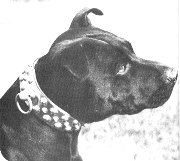
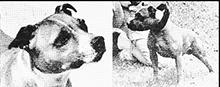
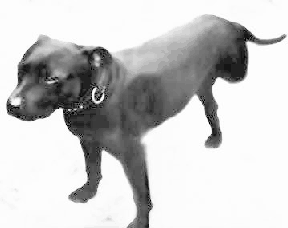
Even from the first there was something special about the black brindle pup. He was just a little smarter than the others---just a little stronger and just a little braver. There was something oddly noble in the jaunty tilt of his head, and he had a kind of regal sparkle in his eye. So they named him Monarch---Rossisle Merely A Monarch (photo on left)---and they taught him to live like a Stafford of the royal line.
His ancestors were "pit" dogs who made their living by fighting other dogs. "Staffords are a fighting breed," he heard over and over. "A Stafford should never start a fight, but he should never fail to finish one."
And there were other things: "A Stafford possesses great courage," they said. "A Stafford is faithful to his friends, especially children... .A Stafford is quiet and trustworthy...A Stafford will do anything for his owners... Staffords are the foremost all-purpose dog!"
To prove all this, there were stories. He heard about Jock of the Bushweld, the national dog of South Africa who was a Stafford and a great hunter. He learned of Staffords who herd sheep and others who hunt wild boar. There were tales of a moose-hunting Stafford and of the many who went into police work. And there was Buller of Looe.
Buller had been a "pit" dog for six years. Then an Englishmen, named Tom Walls taught him to be a retriever. Buller learned to retrieve seven pheasant in rotation.
They taught him all this, but always added: "The children are the most important. A Stafford will never harm a child. And he will die, if he must, to protect one."
This was the Monarch's heritage, and he knew he had to live up to it.
Then came the unexpected word: "Sold! Monarch you've been sold!" And it was true. He didn't know at first what it meant, but he found out. He had been purchased by an Englishman who lived in America. He would have to leave everything and everyone he loved.
"Hiya, butch." said the Englishman when they met. And suddenly he wasn't the Monarch anymore. "Butch" he became forever after. Then they shoved him into a bare, ugly crate and put him on a plane for Birmingham, Alabama.
But he found a good life there. The Englishman was kind, and there were children for butch to play with. He had plenty of food and a good, warm place to sleep---and he was loved.
He grew from a puppy into a strong and handsome dog. In time he forgot he had ever known anything different. But he did not forget the stories he had heard, or the rules by which a Stafford lives. Above all, he did not forget the importance of children. And the day came when he proved it.
He was playing in the front yard with his Children when the garbage truck arrived. Butch didn't understand about trucks, it wasn't a truck at all. To him it was some horrible, grinding monster that threatened to hurt his Children-- and he attacked it. He didn't just run toward it and bark. He tore into the right front tire with a savage fury. In the process, the truck ran over him.
The children were safe, but Butch's back left leg had been crushed. It had to be amputated. That was a low point in butch's life---but things would get worse!
When Butch returned home, there were things he had to learn. Nothing was quite the same with only three legs. but he got used to it, and finally he could do anything he had ever done. He hardly missed the leg at all.
He could even fight, if other dogs wouldn't leave him alone. But the fighting---even though it wasn't really his fault---took him a step farther down the road to rags. He loved people. But he was beating larger dogs---and that made some people afraid of him, too! The neighbors wanted the Englishman to send him away.
The Englishmen tried to explain, but it did no good. They insisted, and finally the Englishman gave in. Butch would be sent to a new house. The only problem was, nobody wanted a dog with three legs.
Then they found a man in Omaha, Nebraska, who loved Staffords. The man couldn't keep Butch because he already had Staffords of his own. But Butch could live there a while until the man could find him a home. The Englishman shut him up in another crate, and sent him on another trip.
The man in Nebraska was nice, and he worked hard to help. But he could not find a family and children with room for butch.
Everything had gone wrong. The man was his friend, but he had nobody else. And he had to sleep outside The yard was a lonely place, and he was lonely. No one came to see him, except at meal time, and, in some strange way he could hardly understand---the loneliness made him hurt It seemed to last forever.
And then he found Mary. And after Mary there was Neil, and then the kids. Anita and Debby, Tony, Scott, and Leslie. The loneliness was over.
It happened one day when butch went to college with the man. The man was a teacher, and he wanted to show his class a Staffordshire bull Terrier. Butch walked into the room, and there was Mary---and she wanted him.
She took him home to meet his new family. He fell in love with all of them---and the family began to discover what life was like with a Stafford.
Butch didn't like the man who delivered newspapers, so he tore the paper to shreds. Night after night there was nothing left but white confetti with black spots. This continued until Mary convinced him that the paper belonged to her and she wanted it. Then he saw everything differently. He never tore it up again.
They all thought that butch's having only three legs might limit his activities. But they discovered that he could play even the wildest games. He loved wrestling with Neil or chasing a ball for Anita and Scott. He loved playing tag with Leslie, and he loved tug-of-war with one of Debby's old sweaters. And with Tony---the youngest---he loved everything. Tony could even ride him like a horse.
But Butch was not all fun where the kids were concerned. If Tony was sick, Butch was worried and unhappy. If one of the neighbor's children got too rough with one of butch's children, butch would separate them gently so that neither got hurt. And at night, he was always on guard for the familys protection.
It was a fine life with Mary and Neil and the kids, and if nothing remarkable had ever happened, it would still have been plenty good. But once his luck changed for the better, it reallv changed!
The Omaha Playhouse was going to do the musical OLIVER! and they needed a dog to play Bullseye. The part called for a Staffordshire Bull Terrier. There were several Staffords in Omaha who could have done it, but there was still that special "something" that Butch had had since he was a puppy. Everyone agreed he should have the part.
Butch went with Mary to the playhouse and started learning to be Bullseye. By opening night, his performance was perfect. He enjoyed his acting---especially the curtain calls---when the audience clapped for him and the rest of the cast.
So Butch made history for himself, and for his breed. The performance of OLIVER! at the Omaha Playhouse was the first time any dog had ever appeared in the theater of that city. And it was also the first time that a Staffordshire Bull Terrier had appeared on a public stage in America.
It had been a long way from the luxury of The Isle to tragedy and loneliness in America, and then to success on the stage. But the most important thing was that he finally found the only riches that are really important to a Stafford. He had a place in the world with a family to love, and to love him---and he had five kids of his own. To Butch, that was all that mattered.