
Staffordshire Bull Terrier
I have copied this article from "THE BOOK OF THE DOG", Edited by Brian Vesey-Fitzgerald, published in 1948 by Borden Publishing Co., Los Angeles, California, USA. It speaks for itself.
STAFFORDSHIRE BULL TERRIER
By PHIL DRABBLE
Like most of the worthwhile things in life, a good Stafford is not attained without effort on the part of his owner. If he is thoroughly trained and well exercised, no dog could possibly be a more delightful companion. On the other hand, an untrained, under-exercised Stafford can do more mischief in a few moments than any dog I know.
This is easily understood when it is realised that Staffords have been bred for more than a century for the sole purpose of dog-fighting. When bull-baiting finally ceased, about 1835, the men who worshipped at the shrine of the Game Dog transferred their devotion from the bull-ring to the dog pit. Dog-fighting had long been very popular and bulldogs had been crossed with various terriers to produce the combination of dauntless courage with agility and endurance which was even more necessary in the pit than the ring. At first, the resulting crossbreds, which must have been anything but uniform, were called "bull-and-terriers" and, as the best of them were used for breeding, a new breed was gradually evolved which became known as 'bull terriers." Some of these bull terriers took after their bulldog ancestors and were quite heavy "cloddy" dogs of up to 50 lbs in weight. Others, which took after the terriers, were only between 10 and 20 lbs. There was no "type", as the term is understood by modern dog-breeders. Men did not care what they looked like so long as they would fight; and, if they would not fight, they went in the water-butt no matter how good looking they were.
Between 1860 and 1870 these bull terriers were split into two camps. James Hinks, of Birmingham, who had always loved a game dog, produced a white strain which he registered at the Kennel Club as "English Bull Terriers". It is believed that they were produced by crossing the original bull terriers with Dalmatians, and much of their gameness was quickly sacrificed for looks, which was the only commodity paying dividends in the show ring. The original breed, which was still unspoilt by crossing with dogs which had not been bred for gameness, was now barred from the official title of Bull Terrier and it gradually became known as the Staffordshire Bull Terrier to distinguish it from the newer breed. The reason that Staffordshire was used as the qualifying term, to distinguish between the old and the new, was that the colliers and ironworkers of Staffordshire were so attached to dog-fighting that the sport became practically localised in the Midlands.
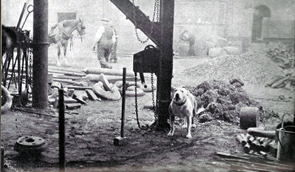
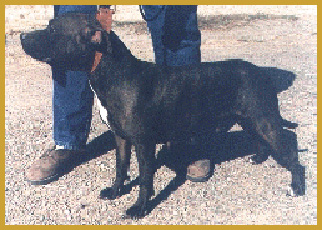
Half a century went by without the popularity of dog fighting waning, despite spasmodic brushes with the police. Nothing had been done to standardise any type, for courage and physical fitness were still the only things which mattered. Any dog which proved unusually successful in the pit was certain to be used as a sire irrespective of his looks and there was still a wide variation of types which have since become curiously localised. In the Walsall district it is common to find dogs of 34-38 lbs which are tall enough to convey a suggestion of whippet in their ancestry. My own theory of this is that a faint cross of bull terrier was sometimes used to impart endurance to whippets and it is possible that the offspring of one of these crosses displayed sufficient aptitude for fighting to have been crossed back to bull terriers, for agility in the pit is as necessary as courage. Only a few miles from Walsall, in the Darlaston district, the Staffords obviously favour their terrier forbears. They are much "finer" in the muzzle and obviously "terrier faced." They are smaller altogether and lighter boned, turning the scale at from 25-38 lbs, and occasionally even lighter. The Darlaston men say all the others "must have been crossed with mastiff" and that "theirs" are the only real Staffords.
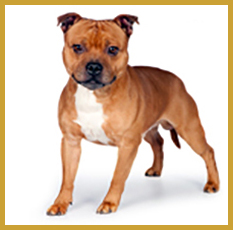
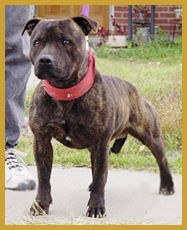
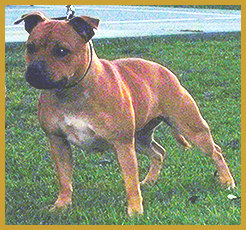
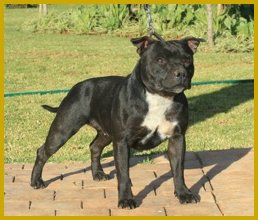
To confound them both, there is a third type to be found in the Cradley Heath area a few miles to the west. This time it is obvious that some members in the pedigree had more than a nodding acquaintance with a bulldog. Short, thick muzzle and broad skull, tremendous spring of ribs and breadth of chest, muscles which seem to be symbolic of power, everything combines to convey an impression of doggedness. This time agility has been sacrificed for strength and yet there is an unmistakable resemblance between all three types. The expression of the face is the same and the way the tail is carried drooping like a pump handle; the characteristic high-pitched staccato bark and the mincing springy walk, which emphasises the constant craving for action. Who can say that one type is "right" and the others "wrong"? Who can say that this dog is a "real" Stafford and that is not? Until very recent years, nobody minded very much so long as each was willing to give a good account in the pit. But that is changing now.
In 1935 it occurred to a band of owners that, as the police had become so extra-ordinarily fussy about dog-fighting since the Great War, it might be a good idea to arrange dog-shows as an alternative attraction. Accordingly, a schedule was drawn up to depict a scale of points for judging and the Kennel Club obliged by "recognising" the breed as the Staffordshire Bull Terrier.
It was natural that the men who drew up the scale of points should model their ideal from their own particular strains, which happened to be the "bulldoggy" type in favour in the Cradley Heath district. The result has been very far-reaching. Due to the publicity acquired from organised dog shows the popularity of Staffords has soared and their market value has been inflated in the same ratio. This attracted a new type of owner who is interested more in the value than the gameness of the breed, and who is loud in his assertion that the show type is "right" and that the show enthusiasts will "standardise" the breed and eradicate all which do not conform to the standard.
I feel very sorry about all this for I think it is a great pity to try to "breed out" all the types which do not conform to such an arbitrary standard. Fighting was the original purpose of the breed, yet all which do not waddle round the show ring without any display of fire are penalised. I have heard long arguments about which type is best for the pit. Some like the "reachey" dog, like the Walsall breed, because he can "fight down" on his adversary. Some like the stocky Cradley type because they are hard to knock off their feet. Some like the little terrier-like dogs which are so nippy and can do such damage by shaking. In the pit one triumphs today and another tomorrow. Despite the fact that failures were not given the opportunity to perpetuate their like, there were many good dogs of each type that there could have been nothing to choose for prowess. Yet the money to be by made by selling "pedigree" dogs is inducing owners not only to "standardise" to an arbitrary type but to exaggerate the points of that type, so that it appears more powerful by being thicker and lower to ground and bigger in skull than was any dog which fought in the pit.
This extraordinary variation in type of Staffords is by no means confined to physical appearance. All good Staffords are game, but some are essentially boisterous and rough while others are equally docile and gentle, both characteristics being passed on through strains as definitely as physical appearance. Two very famous dogs, which I happen to have known very well, exhibited these tendencies to a marked degree--Ch. Gentleman Jim and Great Bomber. Jim was all that his name implies, and generally speaking his offspring are tractable, intelligent and easily trained. Bomber on the other hand just could not keep still, was overflowing with boisterous friendliness and extremely headstrong. His type need an exceptionally firm (and occasionally heavy!) hand to control, whereas it is easy to hurt the gentler type's feelings and make them deeply offended with a few harsh words.
No dogs are physically tougher than Staffords, for they seem almost impervious to pain. I have seen my own bitch, which is "broken" to ferrets, go into the ferret pen to see what she can scrounge. One of the ferrets "pinned" her through the lip and hung on, which must have been pretty painful. Yet she didn't get annoyed or make any fuss but calmly came to find me to have it throttled off. It is this indifference to pain which makes them such peerless fighting dogs. Almost any dog will fight if he is winning, but it takes an exceptional dog to fight a long losing battle and then go back for more, when he has the chance not to; yet a good Stafford will go back so long as he can crawl across. Despite this the breed is not naturally pugnacious, and it is unusual for a Stafford to begin his first fight. He is either "set on" by someone or attacked and fights back in self defense. But once he (or she, for bitches will fight) has tried fighting there is nothing they would rather do. And that is why I advise no one but a real enthusiast to embark upon the ownership of one of these dogs. The man who wants a dog for a household pet, but who expects it to run loose and look after itself will soon regret his choice. I have known them run loose in the streets and play with other dogs for two or three years. But sooner or later they either get hurt playing or mixed up in someone else's quarrel and suddenly realise what fun they have missed. From that time forth they need no second invitation and they fight to kill. Neither water nor any of the usual remedies will part them and I have seen a dog fighting a collie twice his size in a canal, where the owner of the collie had thrown them to part them. But the terrier could not loose and they both very nearly drowned before we could get them out. And owners who are not enthusiastic are often averse to getting sufficiently mixed up in the bother to choke their dog off, which is the only effective way.
Anyone who is willing to take the necessary pains to train and exercise a potential handful of trouble will be amply rewarded by finding it far less onerous than he thought. He will get devotion undreamed of in lesser breeds-and "Stafford men" regard all other breeds as curs. He will get a dog which is a peerless companion for children, though it will be necessary to watch that he doesn't "help" too vigorously if his young master has a quarrel with a playmate. He will have a dog which is unbeatable on rats and will be game to have a go at any other quarry his master selects. Some Staffords have made very fine gun dogs but, oddly enough, a high proportion are gun-shy, though often not initially. My own bitch for instance, came shooting quite happily at the beginning of her first season. She gradually took a dislike to the gun and it almost seemed as if it wasn't the bang to which she objected but that she came to realise that something got killed when it went off and that my marksmanship wasn't so hot. Similarly many Staffords make fine water-dogs and I have seen them matched to beat spaniels and retrievers over a distance, but it is necessary to introduce them to water gradually and in warm weather, or they often will not take to it at all.
In a word, the Stafford is a dog of very exceptional character. Take great pains to develop it and direct it into useful channels and there is no breed in the world as good. Let it grow haphazard without training or care and you will have a villain whose only aim in life is to fight. "And to keep a fighting dog", they say, "you have to be a fighting man."
Phil Drabble