
Article 1
We received this article in the early 1980's from Lillian Rant. She said it was one of her favorites. It was written by a friend of hers, Fred (Freddie) Phillips.
Fred Phillips was raised in the Black Country of England and was acquainted with many of the old-timers and contemporaries of the breed. He had very strong opinions on breed type. We happen to agree with him.
By Fred Phillips
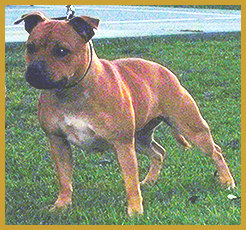
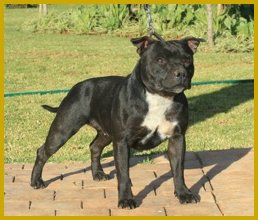
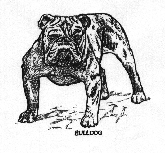 The origin of the Staffordshire Bull Terrier have never been told. Although books were written in the 1930's none have ever given any description of the dogs and bitches from which present dogs have originated. I know that a great deal of controversy will start when I say that in my opinion there is very little Bulldog in the make-up of the Stafford. The only thing that, I think, compares to the Bulldog is it's courage. The Old Bulldogs were more like a Stafford than the present-day Bulldog, but it would be a nightmare to today's Stafford breeder if his Staffords looked anything like a Bulldog.
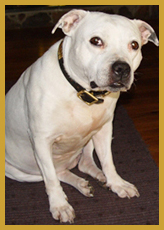
The Stafford's head should be tight without wrinkle over both skull and foreface. He must be devoid of any sign of lippiness. A lippy dog, if fought, would risk losing half his face in the first few seconds of any serious encounter. The essential thing is that the dog's appearance should convey his ability to do his rightful work, even if he doesn't have to fight and is bred only for show. The Bulldog's mouth is undesirable for a Stafford and the prized flews of the Bulldog are well and truly out with the Stafford. The dish and down face, and the head without a stop, should also be avoided.
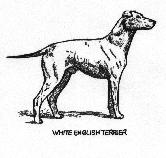 The White English Terrier, now extinct, had all the similarities of the Stafford, other than showing great strength and power for size. The head was as clean-cut as the Stafford, but not strong enough and not deep enough to fit a well-balanced Stafford. The head resembled a wedge, whereas that of the Stafford resembles a half-brick. The skull and foreface of the English were parallel to each other, thus avoiding either dish or down face, and the stop should be deep, since it determines the size and shape of the eye, which should be round with a shallow stop. The foreign eye shapes appear and destroy the typical expression. Ears were small and rosed - if they were large they were cropped. The neck of an English was longer than the Stafford, without the power. The old-timers wanted a neck of reasonable length and great strength and demanded a crest of neck. This permitted a wide range of vision without presenting a vulnerable target, and gave the Stafford the regal stance.
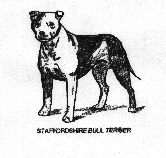 The front of the Stafford is of great importance. The legs must be set in line with, and squarely underneath, the shoulders, with the rounded brisket lying snugly between them. They should be straight to the pasterns, with the feet turning out a little, to enable the dog to brace himself and resist being thrown, or bowled over by another dog, as a wrestler makes a stand. The structural efficiency was most important with two evenly matched Staffords. Many judges judge a Stafford from the front. They admire the great breadth of chest and shoulders and large head, without determining whether this is in balance with the rest of the dog, and many broad-fronted dogs have what is known as a Bulldog front with no breadth of rib-cage, and no indentation behind the shoulders into the ribs. The Stafford should be nothing like the Bulldog, whose shoulders appear to be just tacked on with the body slung between them.
Breeders today are trying to breed dogs like our terrier ancestors, not like the Bulldog which they are supposed to have come from. The faults which are now so noticeable have come from the Bulldog, not the White English Terrier, and I state that the topline should be level, another terrier attribute that is totally unlike the Bulldog, who has a pronounced dip behind the shoulders with roach back and stern higher than the shoulder. We do not want the straight stifle and hock of the Bulldog. When the Stafford is seen from behind, the hind legs must be in a straight line from the hip to foot, again the shape of the Terrier with the bone strength, and without the cowhocks, which are such a feature of the Bulldog.
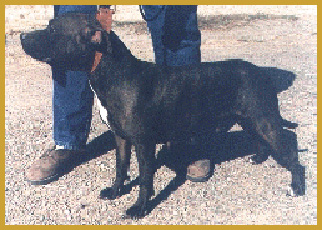
The Stafford is, or should be, a strongly built compact dog, and the ones which are termed very square are the ideal type. The rib-cage should extend for a good two thirds of the body, with a very short space between the last rib and the hind quarters. This correct conformation gives that characteristic devil-may-care gait that is so different from other terriers, which have narrow shoulders and rib-cage, and slightly longer back, making their movement like an articulated truck. Hence all that desired compactness is lost. The Stafford should strike one as jaunty and extremely light on its feet, despite his strong build. He should never appear to be ponderous, or to give the impression of heaviness, which is found in the Bulldog cloddy type of dogs. Terriers, which we can assume to be part of our ancestry and were similar in build, are the Manchester Terrier and White English Terrier. The main difference is the coulour. Liver and black and tan were not to be encouraged. A black Bulldog is never seen, as the Bulldog standard bars the colour black. Therefore if the Stafford came from the White English Terrier and the Bulldog, how did the black Staffords originate? After looking back at what was supposed to be our main ancestors, one can only assume that other breeds had to be applied. Having examined the origin of the breed, one moves to the characteristics, and it is from the past history of the Staffordshire Bull Terrier that the modern dog inherits his character of indomitable courage and high intelligence, his great affection for his friends - children in particular - his quietness, and his trustworthy stability, which makes him the foremost all-purpose dog.
The Stafford is not indiscriminately aggressive with other dogs, but if challenged usually responds with eager briskness and his memory is long. If he is attacked by a dog of another breed he will harbour a dislike for all members of that breed, in or out of the show ring.
Fred Phillips