

Article 3
This article was originally an e-mail response, posted to the SBT Forum E-mail List. There were two e-mail list servers for the Staffordshire Bull Terrier Breed. Both lists had a thread running for over a week. The subject of the thread was the "size" of the Stafford. At this date there had been more than 130 responses to this thread on both lists. Mr. Stone's response is the Battleship Missouri-Cruise Missile response to the Mother-of-all e-mail threads. No more is to be said, or should be. He says it all.
Email from Chris:
Date: Sat, 28 Mar 1998 12:26:20 -0700
To: SBT Forum
From: Steve Stone
Subject: Re: Size
Chris Wood wrote:
Well since no-one else is speaking I guess I will try to stir things up a bit.
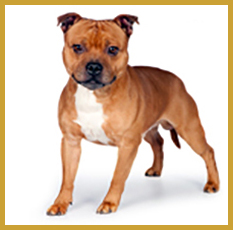
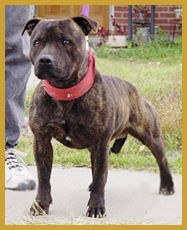
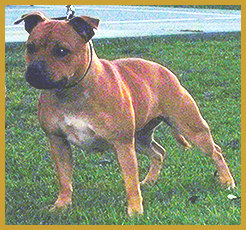
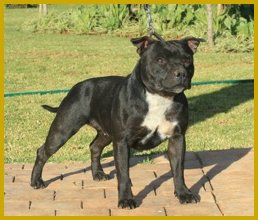
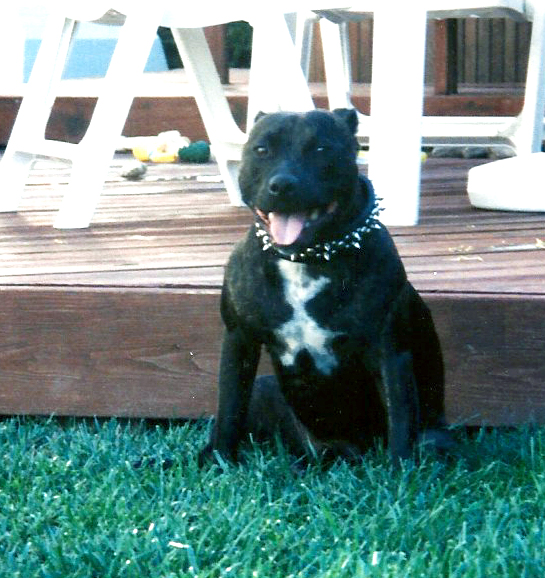
There is such a great diversity in the size of Staffords. I have owned pits in the past, and while I have never been a participant in a pit fight, I have seen several champions and they have all been very svelte animals. Lean and full of raw power, they were very agile. I have been exposed to only a few Staffys in person, though I have seen many in pictures, but it seems that many of them that are winning in the ring are muscular to the point of being stiff rather than agile. While I disagree with the thought of fighting dogs, everything I have read in the standard as well as several books indicates that we should strive for the more nimble, athletic build.
I guess my main question is, if the standard calls for a very athletic animal which "should be of great strength for its size and, although muscular, should be active and agile." Why are so many muscle bound dogs winning at shows? Understand that being relatively new to the breed, this question is asked out of ignorance and I welcome all input on this subject.
Steve's answer:
Chris - First, just a gentle reminder: you get more mileage by referring to the dogs as Staffords rather than Staffs or Staffies.
Now to the meat of your post. As you know, probably the most demanding activity any mammal can undertake is fighting, which includes boxing for people and pitfighting for dogs. In a sense, it's the ultimate tests of athleticism and carries a powerful survival factor. Today, no legitimate activity for Staffords exists that can even approximate the physical demands for athleticism required by fighting, and even if there were, not many Staffords owners would allow, much less encourage, their dogs to participate.
Some time ago on the other list there was a thread on exercising Staffords through running (alongside a bicycle, for instance), and a fairly high percentage of those contributing to the thread said that since Staffords were not bred specifically to run (as racing Greyhounds are) they should not be encouraged to run or even allowed to run because doing so might overstress them. They were seemingly unaware that human boxers and canine pitfighters are conditioned primarily through roadwork, that is, running, for in conditioning gradually increasing the stress load serves as the principal factor. you can bet that Joe Mallen's stock could run!
Lacking a true test of athleticism, most Staffords belong to owners of what might be called non-athletic inclination, meaning persons who have no personal interest in any kind of athleticism for themselves or their dogs, persons with no real knowledge of or interest in what was once required. In and of itself, this could hardly be considered bad, but an aesthetic aversion to the patently harsh facts of pre-KC Stafford life prevents many of them from even making more than a cursory study of relevant material which they tend to either ignore or reject.
Yet each of them would be quick to state that he/she wants a dog that LOOKS LIKE it could do the job, if only they knew what such a creature SHOULD look like... So, instead of striving for real athleticism most of them are content with what they consider to be the appearance of power.
Thus, Staffords with impressive-looking musculature have tended to get the nod in breeding programs so that, incrementally, each successive generation tends to be bulkier than the previous one until finally "cloddy" Staffords appear. But by then, cloddy seems normal and right in the eyes of breeders (many of whom have too little experience in the Breed) who then strive for even greater display or muscularity. And so it goes, unchecked.
While it is only too true that judges can only judge what is placed before them, today very few judges have genuine familiarity with the Breed and its history. On the other hand, Stafford specialist judges tend to be breeders or former breeders who themselves have been blindsided by the cloddiness factor.
All these attitudes and their consequent actions are minute by-products of massive socio-economic forces that drive this modern society, of which the Staffordshire Bull Terrier movement comprises a perfectly insignificant fraction. Like it or lump it, we must resign ourselves to this fact: no individual or a group can even slow these forces down.
Those who don't like the inexorable change have three choices: 1) play the game, 2) play a lone hand, 3) quit.
Steve Stone