
Sweating off the Pounds
by Rick Smith
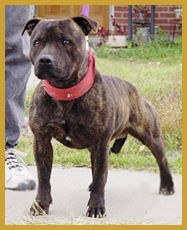
First, physical workouts rather than feed control must determine your dog's weight. In my early experience with the Stafford, I felt I should present a fit animal with a tucked at the loins and nice line of muscling down the back, but I was mistaken. Most Staffords shown in the U.S. appear in less than fit condition and show too little tuck. Fit animals are the exception rather than the rule.
We must care first and foremost about the condition of our Staffords. Each dog must be free of internal and external parasites before beginning any conditioning, and it should also be fairly lean before undertaking vigorous activity. Further, a thorough blood workup must verify its health. Meticulous observation of the dog's overall health and the use of common sense must be maintained by constant vigil.
After the dog has proven itself in shape to begin a workout regime, we need to focus irst on the its feet, which is very important. If the dog gets a cut or worn pad and cannot continue its workout, we are wasting valuable time. (As they say in horses, "No hoof, no horse.") Begin with a nail trim and then work on toughening the pads. Scarlex, an aerosol spray, may help toughen the pad. Also apply Bag Balm ointment liberally on each foot before a workout to keep the pads supple.
Hand walking, also called roadwork, is the most important element of all workouts because it is the only exercise that man and beast can perform together, and neither can get too much of it. (It is also the only exercise to give a puppy less than one year old.) Try to use the longest lead that will allow you to control your dog safely, and walk it in a place free of strays and other distractions. Start the dog with as little as one mile per day and work your way up to five miles of brisk non-stop walking. Be constantly alert for signs of fatigue and/or lameness and rest the dog until the next day or even longer if either appears. If the dog continues lame or suffers an injury, use common sense.
Once the dog is fit for a vigorous walk with intermittent running, begin extended sessions of fetch, jogging, or running alongside a bike. The more contact with the animal the better, be it at the end of a leash or just taking a ball from its mouth.
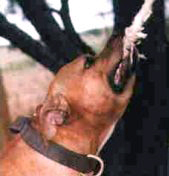
Bazooka Joe hanging from a spring pole.
Next, take an old garage door spring, heavy rope, and cowhide (or heavy-duty rubber) and connect all the parts and hang the device from a solid mooring so that the dog can work it while keeping its hind feet on the ground. This is a "spring pole," and Staffords invariably love working with it. This vigorous tug-o-war "toy" will strengthen your Stafford from its jaws to its hindquarters and improve its physique faster than you can imagine.
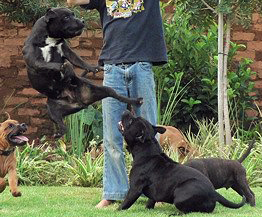
Now that the dog can walk, run and pull, it is time to try the "flirt pole." Take a long bamboo pole (the kind you used to use for fishing) and tie a short nylon cord to its end. At the end of the cord, tie a small toy and let the dog chase it around at a sprint, leaping and jumping at it to develop its hindquarters. Most Staffords will chase a flirt pole until their trainers give out.
After each vigorous session of any activity is completed, walk the dog half a mile to cool it out, and then give it an hour or more of rest before feeding.
Again, the trainer's common sense is the key element. He/she should push the dog as far possible but without over-exerting it and increase the workout incrementally over the course not of days but of weeks.
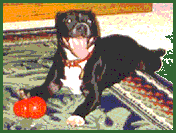
Play time
Breeders or exhibitors can control only:
- Selection of show and brood stock.
- Selection of mates.
- Training and conditioning stock and progeny.
The last item is by far the most enjoyable one because it requires the greatest degree of active intimacy with the Stafford and involves the greatest degree of control.
by Rick Smith