The Standards
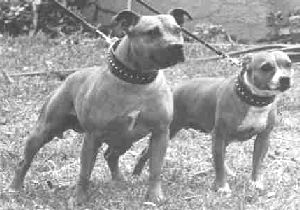
The Old Original Standard - England 1935
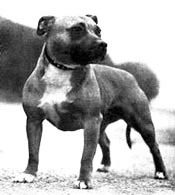
| General Appearance | The Staffordshire Bull Terrier is a smooth-coated dog, standing about 15 to 18 inches high at the shoulder. He should give the impression of great strength for his size, and although muscular should be active and agile. |
| Head | Short, deep through, broad skull, very pronounced cheek muscles, distinct stop, short foreface, mouth level. |
| Ears | Rose, half prick and prick; these three to be preferred, full drop to be penalized. |
| Eyes | Dark. |
| Neck | Should be muscular and rather short. |
| Body | Short back, deep brisket, light in loins with forelegs set rather wide apart to permit of chest development. |
| Front Legs | Straight, feet well padded, to turn out a little and showing no weakness at pasterns. |
| Hind Legs | Hindquarters well muscled, let down at hocks like a terrier. |
| Coat | Short, smooth and close to skin. |
| Tail | The tail should be of medium length tapering to a point and carried rather low; it should not curl much and may be compared with an old-fashioned pump handle. |
| Weight | Dogs 28 to 38 lbs., Bitches 4 lbs. less. |
| Colour | May be any shade of Brindle, Black, White, Fawn or Red, or any of these colours with White. Black and Tan and Liver not to be encouraged. |
| Faults to be Penalized | Dudley nose, light or pink eyes (rims), tail too long or badly curled, badly undershot or overshot mouths. |
The AKC Standard - Currently Published
The first two Staffords registered in the USA with the first USA Staffordshire Bull Terrier Breeed Club (SBTC/USA):Bandits Belle Lettres & Bandits Firestreak Red Rover Did you know?Staffords need some form of rigorous physical activity to maintain proper muscle tone. Staffords have great affection for people, especially children. Was recognized by the Kennel Club of England in 1935. Was admitted to registration in the American Kennel Club Stud Book effective October 1, 1974. So you want to own a Staffordshire Bull Terrier?Staffordshire Bull Terriers are gentle, affectionate, trustworthy, and loyal. The Staffordshire Bull Terrier can have a very high prey drive. The need to be socialized around other animals but can still be aggresive towards other animals; but never people. |
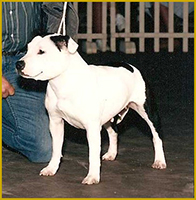
General AppearanceThe Staffordshire Bull Terrier is a smooth-coated dog. It should be of great strength for its size and, although muscular, should be active and agile. Size, Proportion, SubstanceHeight at shoulder: 14 to 16 inches. Weight: Dogs, 28 to 38 pounds; bitches, 24 to 34 pounds, these heights being related to weights. Non-conformity with these limits is a fault. In proportion, the length of back, from withers to tail set, is equal to the distance from withers to ground. HeadShort, deep through, broad skull, very pronounced cheek muscles, distinct stop, short foreface, black nose. Pink (Dudley) nose to be considered a serious fault. Eyes-Dark preferable, but may bear some relation to coat color. Round, of medium size, and set to look straight ahead. Light eyes or pink eye rims to be considered a fault, except that where the coat surrounding the eye is white the eye rim may be pink. Ears-Rose or half-pricked and not large. Full drop or full prick to be considered a serious fault. Mouth-A bite in which the outer side of the lower incisors touches the inner side of the upper incisors. The lips should be tight and clean. The badly undershot or overshot bite is a serious fault. Neck, Topline, BodyThe neck is muscular, rather short, clean in outline and gradually widening toward the shoulders. The body is close coupled, with a level topline, wide front, deep brisket and well sprung ribs being rather light in the loins. The tail is undocked, of medium length, low set, tapering to a point and carried rather low. It should not curl much and may be likened to an old-fashioned pump handle. A tail that is too long or badly curled is a fault. ForequartersLegs straight and well boned, set rather far apart, without looseness at the shoulders and showing no weakness at the pasterns, from which point the feet turn out a little. Dewclaws on the forelegs may be removed. The feet should be well padded, strong and of medium size. HindquartersThe hindquarters should be well muscled, hocks let down with stifles well bent. Legs should be parallel when viewed from behind. Dewclaws, if any, on the hind legs are generally removed. Feet as in front. CoatSmooth, short and close to the skin, not to be trimmed or de-whiskered. Color Red, fawn, white, black or blue, or any of these colors with white. Any shade of brindle or any shade of brindle with white. Black-and-tan or liver color to be disqualified. GaitFree, powerful and agile with economy of effort. Legs moving parallel when viewed from front or rear. Discernible drive from hind legs. TemperamentFrom the past history of the Staffordshire Bull Terrier, the modern dog draws its character of indomitable courage, high intelligence, and tenacity. This, coupled with its affection for its friends, and children in particular, its off-duty quietness and trustworthy stability, makes it a foremost all-purpose dog. DisqualificationBlack-and-tan or liver color. Approved November 14, 1989 |
Our opinion on The Standard